PRODUCT · 01
BORA
01 /
Who it is for
Real estate (primary) and banks: runs the valuation lifecycle from bank request to signed report, including title deed queries and regulator record generation.
Where it is used
- Real estate valuation: every step, from the moment a request arrives to the signed report, runs in one place.
- Banking: valuation requests are collected, and the completed report goes back to the bank.
- Title deed and project data: records from different cities are consolidated into a single table; where each piece of information came from stays visible.
- Regulator record: the record to be submitted to the authority is extracted automatically from the signed report.
- Construction and building inspection: the survey taken on site is compared with the approved project, and any difference is recorded.
- Municipality: the building's compliance with the plan underlying its permit is checked the same way.
02 /
Requests, documents, and title deeds
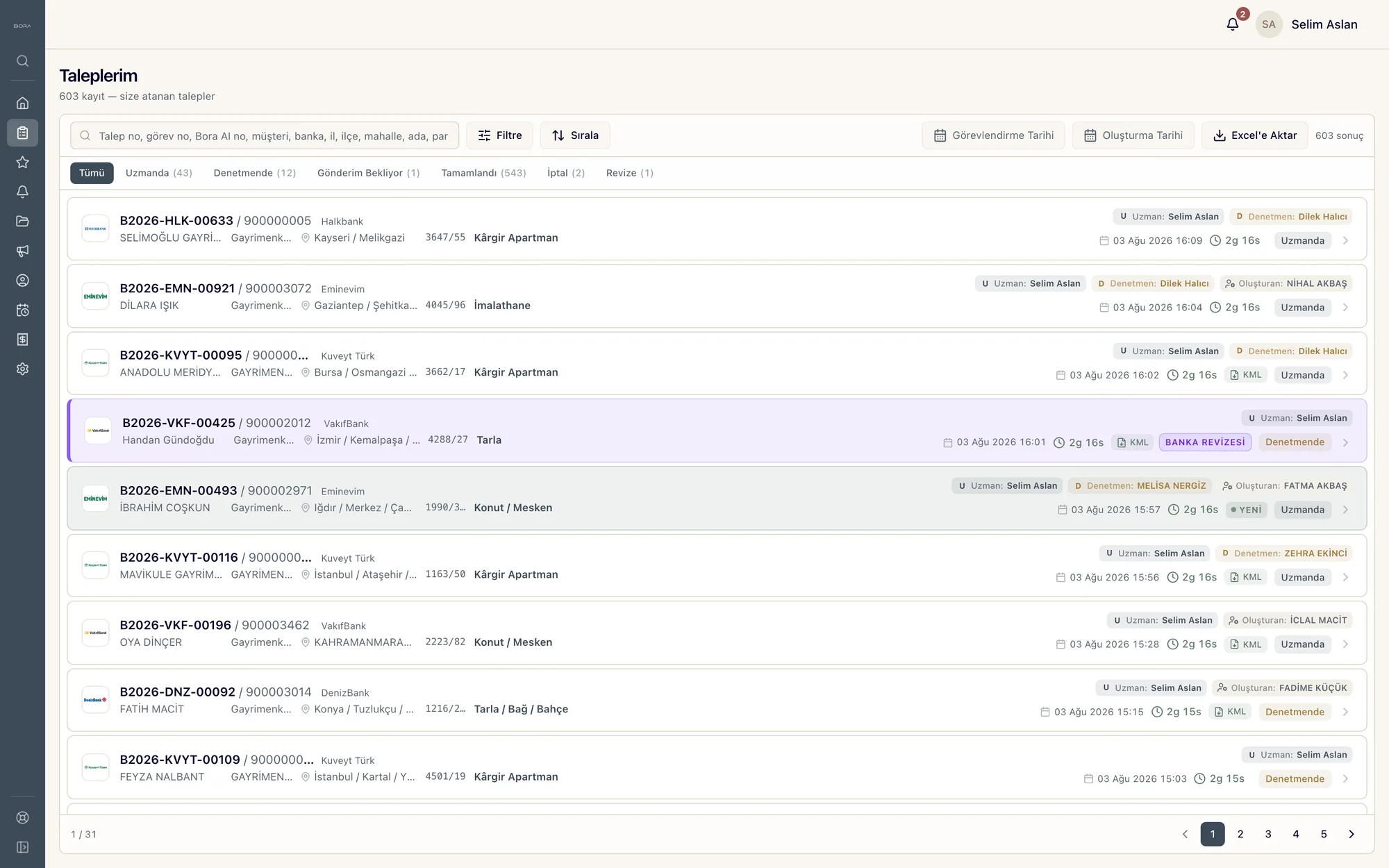
Request intake · Document reading · Title deed and project
When a bank request arrives, automation pulls it in and writes it to the BoraAI platform; there is no manual entry.
The request's attachments and documents pass through the OCR layer; the draft report begins to take shape from this reading.
The title deed record and architectural project are collected automatically from the source system, run through OCR, and entered into the report.
03 /
Assignment and scheduling
Appraiser assignment · Appointment and route
Each request is assigned to the valuation expert best suited to the job by an algorithm that considers workload, years of experience, and location.
The voice agent calls the property owner to book a site visit, writes the appointment to the calendar, and arranges the day by route.
04 /
In the field
Document collection · LiDAR scan · Plan comparison · Data ingestion
At the municipality, the appraiser photographs or scans the required documents with BoraAI Mobile.
At the property, the appraiser scans the interior with LiDAR using the mobile app; the appraiser's work is limited to taking photographs.
The scan is compared with the architectural project through the model; construction that deviates from the project and cut columns are detected and written into the report.
Once the site work is complete, address data, comparable listings, the energy performance certificate, and map images are collected automatically from their sources, flagged, and added to the report.
05 /
Signature and archive
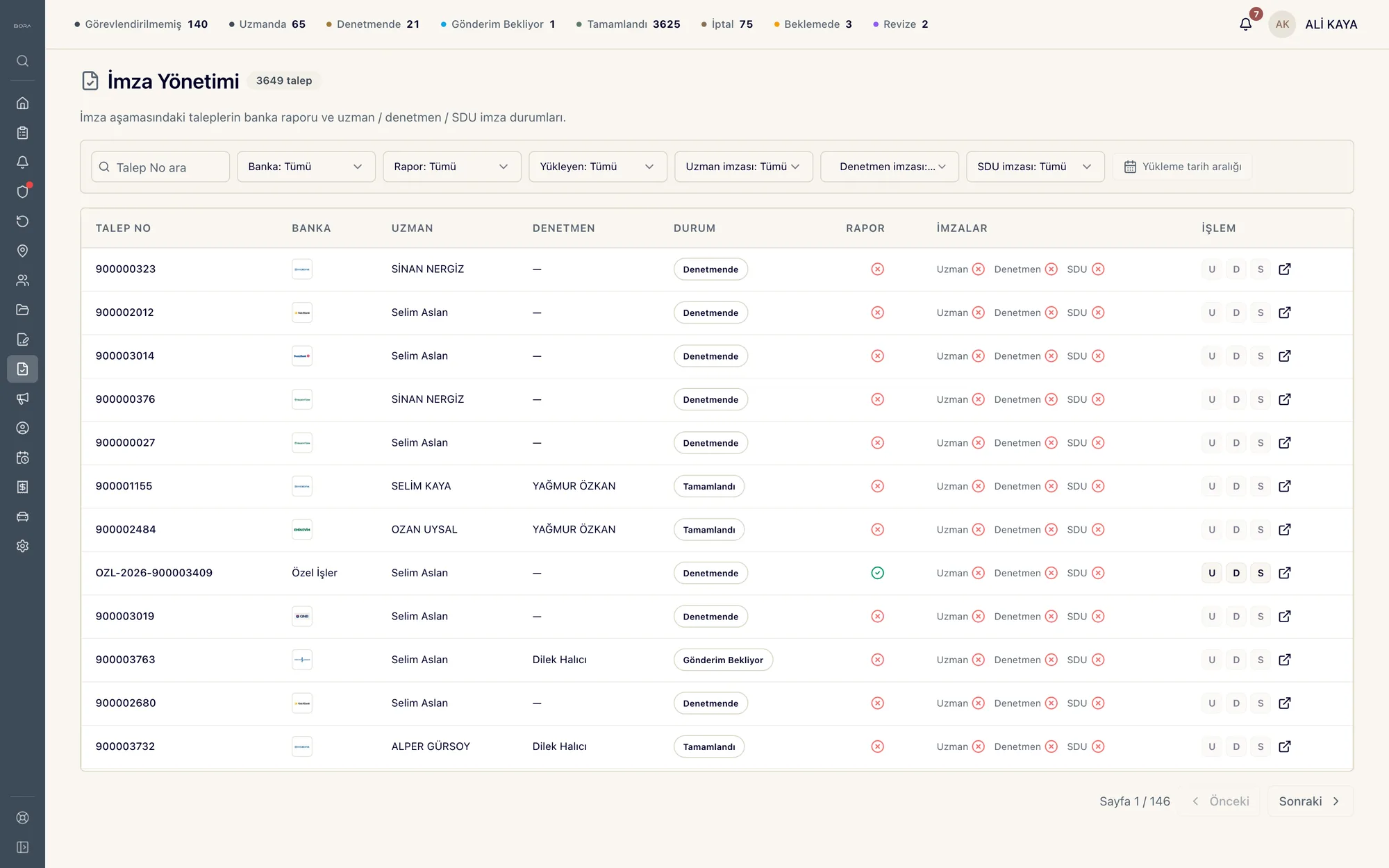
Specification review · Signature and archive
The retrieval pipeline checks the report against the bank's technical specification; it flags errors, corrects them, and scores the report.
A report that passes review is signed and archived automatically; the signature happens within the flow rather than waiting as a separate step.
06 /
End-to-end flow
The flow consists of eleven stages. Nine are run by automation and models; only the sixth and seventh stages are work the appraiser does in the field.
- 01 · Request intake — automation
- 02 · Document reading — model
- 03 · Title deed and project — automation
- 04 · Appraiser assignment — model
- 05 · Appointment and route — model
- 06 · Document collection — appraiser
- 07 · LiDAR scan — appraiser
- 08 · Plan comparison — model
- 09 · Data ingestion — automation
- 10 · Specification review — model
- 11 · Signature and archive — automation
07 /
Platform scope
The platform is shown as a single body; its top is divided into seven compartments.
- Valuation flow — from request to archived report
- Vehicles and fuel
- Personnel
- Regulatory reporting
- Accounting
- Management
- Fixed assets
08 /
From signed report to regulator record
A six-step extraction pipeline from the signed valuation report to the regulator record, and a category breakdown of the 129 fields in the resulting record.
- SIGNED REPORT — the archived report becomes input
- PAGE IMAGE — each page is converted to an image
- READING MODEL — text and images are read together
- FIELD EXTRACTION — 129 fields land in the schema
- RULE CHECK — 23 rules · format, location, city/district
- REGULATOR RECORD — a single record is completed
09 /
Every task writes to the same record, every decision reads the same record
The diagram has three zones: on the left, the jobs that write to objects; in the middle, the objects; on the right, the consumers that read from them. Each object has four faces: fields, functions, actions, automations.
WRITES
- Automation
- Document reading
- Mobile app
- LiDAR scan
- Voice agent
- Collected source data
BORA
- Request — The valuation request from the bank; a single record together with its attachments and documents.
- Property — The asset being valued; with its title deed record, architectural project, and site survey.
- Report — The report from draft to signed version; every version and score is recorded.
- Appraiser — The valuation expert; workload, experience, and location feed into the assignment decision.
- Appointment — Site visit; the time booked by the voice agent and the day's route plan.
- Vehicle — Field vehicle; route record, split between business and personal mileage.
- Document — Documents collected from the municipality and other sources; the report each belongs to is recorded.
- Scan — Result of comparison against the LiDAR scan and the architectural project.
READS
- Dashboards
- Reporting
- Learning models
- Document intelligence
- Specification review
- Audit trail
10 /
Other work run on the same platform
Vehicles and fuel
Vehicle tracking; splitting fuel into business and personal mileage, and calculating the amount owed for personal mileage.
Personnel
Leave tracking, bonus calculation, and payroll calculation.
Regulatory reporting
Generation and reporting of regulator records.
Accounting
Reconciliation and accounting records.
Management
Management reports and statistics.
Fixed assets
Tracking of fixed asset records.
11 /
Related industries

Real Estate
A valuation request runs on a single platform from the moment it arrives to the signed report: title deed and project data are collected automatically, the site survey is carried out, and the report is reviewed and signed.

Finance
Valuation requests, collections calls, and policy questions are answered with the organization's own data, on the organization's own hardware.
Let's talk about your system
Tell us which process you want to automate; we will draw up an actionable plan.